

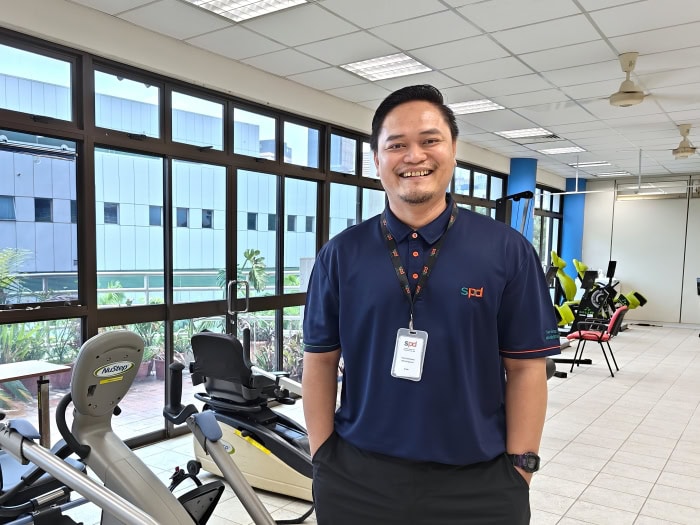
Principal physiotherapist Audi Fehdurani has spent over a decade helping people regain strength and independence through tailored interventions and rehabilitation. In celebration of World Physiotherapy Day on 8 September, we step into his shoes as he reflects on the meaningful moments of working in the community care setting.
__________________________________________________________________________
7:15 AM – Morning Ritual
Coffee is always the first order of the day. At the kopitiam, the stallholders already know my drink: kopi-O kosong (i.e. black coffee with no milk and no sugar). As I wait, I run through the day ahead, with both clinical and mentoring work to be done. Three sites are on the schedule: a day rehabilitation centre in the morning, a day care centre after lunch, and a nursing home in the afternoon. On top of that, I need to finalise a proposal for a Falls Prevention Education project. It’s going to be a full day, but one with a rhythm that I am familiar with.
___________________________________________________________________________
8:30 AM – Day Rehabilitation Centre
My first client is Mr Tan, 81, witty and determined. He calls the parallel bars his “catwalk”. Post-hip surgery rehabilitation is demanding, but his progress is steady. We focus on gait training and balance. I notice that very often, he can do more, taking extra steps whenever he talks about his grandchildren. At the end of the session, he asks if he’s made progress. I smile and simply say “yes”.
There is an assumption that community care is only about maintenance or managing declines. But what I see are victories — a patient walking unaided after months, another climbing stairs independently, or someone falling less frequently. These gains may be modest, but they are life-changing for those who achieve them.
___________________________________________________________________________
10:30 AM – A Different Kind of Weight
In the late morning, I am with Mr Lim, a man in his late 70s who is recovering from a stroke. His physical progress has been steady, but today he refuses to leave his wheelchair. His family member became frustrated. I sat down beside him, and he said to me quietly, “Why bother? I don’t feel like there’s much left to get better for.”
We set aside the exercises and talked. Or rather, I listened. He spoke of his late wife, his sense of uselessness, and the loneliness he felt even in crowded communal spaces.
In undergraduate studies, we were taught to mobilise joints and strengthen muscles. But moments like these remind me that we are also called to witness grief, loss of identity, and the invisible weight our clients carry.
I acknowledged his feelings and reassured him that his progress mattered, both to him and to those around him. I encouraged him to seek support and offered options. This conversation did not solve everything, but perhaps it opened his heart to continue trying.
This session reminds me: we don’t just restore movement; we help restore hope. Sometimes, the most therapeutic thing we can offer is not exercises, but presence.
___________________________________________________________________________
12:00 PM – Shared Lunch
Lunch with colleagues is a welcome pause. We pulled tables and chairs together, peered into each other’s lunch boxes, and shared stories — of a client who insisted an umbrella was a suitable walking aid, another who relearned to write their name, and one who successfully transitioned into open employment. The laughter is genuine, but so is the unspoken understanding of the weight of our work and the impact it has on our clients. Having a supportive team is priceless.
___________________________________________________________________________
1:30 PM – Clinical Supervision: Day Care Centre
I met a junior physiotherapist for a clinical round. There were questions on how to review clients with cognitive impairment and low motivation — common challenges in the clinical setting. We discussed strategies, reflected on practice, and problem-solved together. It’s a mix of teaching, mentoring, sharing and listening.
Clinical supervision is one of my favourite parts of this job. Watching younger colleagues grow in confidence and sharpen their skills is deeply rewarding. When the time comes for them to supervise others, I hope I have prepared them adequately for it too.
___________________________________________________________________________
3:00 PM – Clinical Supervision: Nursing Home
The pace shifts: less gym work, more bedside care. I checked in on a junior physiotherapist working with Mdm Choo, whose stroke recovery has been slow. Neurorehabilitation requires patience, and today we match her pace carefully.
We also worked with a resident who rarely speaks. Today, she smiled at the end of the session. That single smile carried meaning — trust, relief, or the promise of trying again tomorrow. In community care, we learn to interpret these unspoken languages.
___________________________________________________________________________
4:30 PM – Project Work
Back at the office, I turned to project planning. The task is to integrate strength and balance circuits into day care activity calendars. It requires a blend of clinical knowledge, behaviour change strategies, and collaboration with programme staff.
Community care often comes with constraints such as limited space, staff, and time. Yet these challenges often spark innovation. The key is to keep sight of why we do this work and to keep finding ways to move it forward.
___________________________________________________________________________
5:30 PM – Heading Home
As the day winds down, I checked for messages from friends working in other places: some clinical queries, care plan discussions, and light-hearted exchanges. Collectively, we realise that cases are becoming increasingly complex. Having a network across different specialties means there is more space for collaboration, learning, and encouragement.
___________________________________________________________________________
6:30 PM – Home
At home, evenings take different forms. Some evenings are filled with household tasks, others with spreadsheets but often, it is reserved for self-care. Balance looks different for everyone but caring for oneself is part of sustaining this work.
___________________________________________________________________________
Musings before bed
When asked why I chose community care, I often say: “Because the variety keeps me engaged”. It is true — the caseload is broad, the cases are complex, and the work cuts across branches of physiotherapy.
But the deeper reasons are clear: every day I help someone live with more dignity and independence. It is meaningful to witness someone sit up, stand, or speak again. The community care sector is full of untapped potential.
To students, new graduates, or even experienced physiotherapists considering their next step, I would say: do not overlook community care. It is a dynamic and rewarding field that enables professionals to grow their expertise while supporting clients over time—witnessing their progress, celebrating milestones, and making a positive difference in their lives. Opportunities here are plentiful, if you are willing to seek them out.
Plus, where else does a simple “I managed today” from a client carry the weight of a standing ovation?
___________________________________________________________________________
Physiotherapy is more than just exercises and treatment plans. It extends to journeying alongside individuals through their toughest seasons, helping them to rebuild strength, independence, and confidence.
Happy World Physiotherapy Day to all physiotherapists!