


Mealtimes provide a valuable opportunity for connection and communication. But for many caregivers, mealtime may also be a daily challenge. Perhaps your child refuses to eat, plays with food, constantly gets up from the table, or becomes upset when meals are served. These behaviours can feel frustrating or confusing, especially when you are trying your best to support your child.
The good news is that these mealtime struggles are often not “bad behaviours,” but signs that your child needs more support emotionally or socially. In this article, SPD speech therapist Alex Ong shares strategies to make mealtimes a positive experience.
Before diving into strategies, it helps to understand why some children have trouble staying focused or engaged during meals. Challenging behaviours such as walking away, throwing food, or refusing to eat – often reflect underlying emotional or communication needs.

Some common underlying reasons include:
- Difficulty coping with various sensory experiences
Some children, especially those with developmental delays or sensory sensitivities, can feel overwhelmed during mealtimes due to strong smells, unfamiliar textures, loud noises, or sudden changes in routine. When they are unable to express this discomfort verbally, they may respond by crying, withdrawing, or showing challenging behaviour.
- Difficulty communicating needs and preferences
A child who is still developing language skills may not be able to express his/her needs clearly using phrases such as “I don’t like that”, or “I’m not hungry.” Instead, they might push the plate away, walk off, or cry – behaviours that can be misunderstood when the underlying message goes unrecognised.
- Preference for play or screen time
Mealtimes might feel boring or restrictive to a child who prefers to continue playing or watching TV. If eating feels less rewarding than those activities, the child may avoid or rush through meals.
- Feeling pressured to eat
Caregivers naturally want their child to eat well. But sometimes, focusing too much on the need to finish the food can create stress for the child. When mealtime becomes a high-pressure situation, children may resist or shut down, associating meals with anxiety rather than connection.
Understanding these root causes can help us shift our approach. Instead of reacting to the behaviours we see on the surface, we can address the underlying need. The following strategies offer ways to do just that.
Strategies to support positive mealtimes
1. Create predictable routines
Children benefit from structure and predictability, especially those with developmental delays, language disorders, or anxiety. Routines help reduce cognitive overload and promote cooperation during transitions.
Consider this:
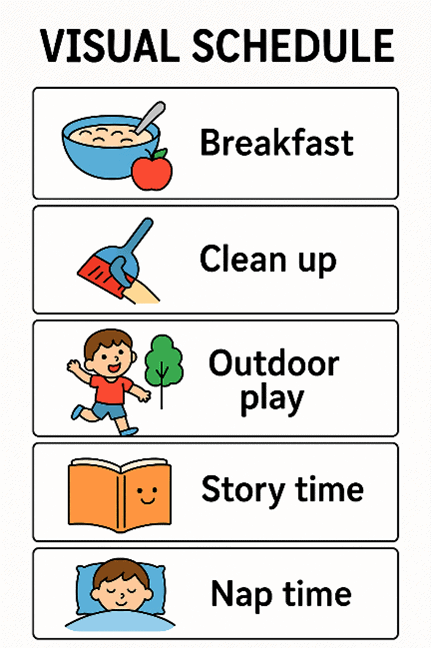
- Set consistent mealtimes each day
- Use visual schedules (such as the one above) to show the sequence of mealtime routines such as handwashing, eating, cleaning up
- Offer countdowns (e.g., “5 more minutes until lunch”)
This is helpful as predictable routines help children regulate emotions and behaviour, especially in unfamiliar or overstimulating situations.3
2. Minimise distractions
A calm, distraction-free environment can improve your child’s ability to stay present and engaged during mealtime.
Strategies:
- Turn off the TV, devices such as tablets or phone, or loud music
- Use consistent seating (i.e. let the child sits in the same place for meals each day – same chair, same spot at the table) and a supportive chair
- Keep table items organised and uncluttered
Research shows that reducing environmental distractions helps children who have attention and executive function challenges engage more successfully in structured tasks like meals.4
3. Provide simple communication tools
Mealtime can be frustrating for children with speech or language difficulties as they are not able to communicate adequately. Offering communication support or augmentative and alternative communication (AAC) can empower them to communicate clearly, reduce behaviour issues and support participation in routines like meals.1
Helpful supports:
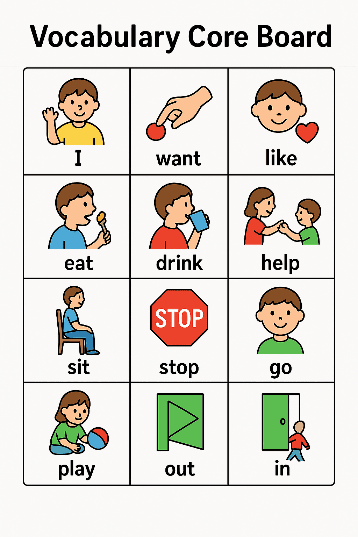
- Core vocabulary boards (e.g., “more”, “stop”, “help”, “all done”)
- Use gestures or simple sign language
- Model short, functional phrases (“More banana”, “No, thank you”)
4. Emphasis interaction
Focus on building connection with your child as you have meals together. Language-rich mealtimes build vocabulary and social-emotional skills while lowering anxiety.5 Positive, pressure-free interaction helps your child associate mealtime with safety, fun, and communication.
Engage your child by:
- Naming foods, textures, colours (“This is soft”, “That’s red”)
- Offering choices and asking simple questions (“Do you want more or less carrots?”)
- Fostering engagement by involving your child in mealtime conversations, such as by asking open-ended questions (“How was your day?” or “What activities did you participate in school today?”)
5. Reinforce positive behaviour
Instead of using bribes or threats, which may often end up in power struggles between you and your child, focus on encouraging progress and effort. Positive reinforcement helps shape behaviour and builds emotional connection.2
For example:
- “You used your words to say ‘all done’. Great job!”
- “Wow, you stayed at the table the whole time!”
- “I like how you tried the fruit today.”
Final thoughts
Helping your child focus and stay emotionally regulated at mealtime takes time, patience, and consistent strategies. Focus less on what your child eats at first, and more on building connection, communication, and calm routines together. Progress may be gradual, but every small step counts. Celebrate the wins and model calm behaviour along the way.
Consult your child’s early intervention or medical team for further guidance on managing mealtime routines or food sensitivities, if needed.
References
- Drager, K. D. R., Light, J. C., & McNaughton, D. B. (2010). Effects of AAC interventions on communication and language for young children with complex communication needs. Journal of Pediatric Rehabilitation Medicine, 3(4), 303–310.
- Dunlap, G., & Fox, L. (1999). A demonstration of positive behavior support for young children with autism. Journal of Positive Behavior Interventions, 1(2), 77–87.
- Evans, G. W., & Fuller-Rowell, T. E. (2013). Childhood poverty, chronic stress, and young adult working memory: The protective role of self-regulatory capacity. Developmental Science, 16(5), 688–696.
- Pivik, R. T., & Dykman, R. A. (2003). Event-related brain potentials during auditory processing in children with attention-deficit hyperactivity disorder. Biological Psychiatry, 53(3), 278–291.
- Snow, C. E., & Beals, D. E. (2006). Mealtime talk that supports literacy development. New Directions for Child and Adolescent Development, 2006(111), 51–66.