


Caring for a child with developmental needs often comes with challenges that go unseen. Over time, stress can build up and affect their mental well-being, especially when caregivers’ own needs are placed last. Research shows that practising self-compassion can make a difference, supporting greater motivation, fostering hope, and significantly lowering psychological distress. SPD’s psychologist Lois Timothy shares practical ways caregivers can begin showing themselves the same care and understanding they offer every day.
A 2022 survey by KK Women’s and Children’s Hospital (KKH) found that 65 per cent of parents who have a child with developmental needs experience mental health challenges that needed to be addressed through professional support.
Although caring for a child can be deeply rewarding, raising a child who has developmental needs often carries added responsibilities – financial strain, coordinating support systems and facing judgement from others.

On top of these, caregivers have to navigate a demanding and complex journey. This may include making decisions about resources, supporting the behavioural and emotional needs of their child, and coordinating doctor’s appointments, pre-school schedules, therapy sessions and early intervention classes. When these stressors accumulate, distress may become unavoidable.
In the midst of these responsibilities, self-blame may quietly surface.
I must have done something wrong. No wonder my child is like this.
Was it something I ate or did during pregnancy? Maybe I could have prevented this from happening.
I cannot manage my child. I’m doing it all wrong. I’m a bad parent.
This contributes to prolonged stress and increases vulnerability to psychological distress.
What is self-compassion?
Many caregivers have probably heard that they are their child’s strongest support system. However, it is equally important to recognise that parents need support too.
Supporting caregivers’ mental wellbeing is a crucial part of healthy parenting. One effective coping strategy is to practise self-compassion, a concept popularised by Dr Kristin Neff. Self-compassion does not mean ignoring challenges or simply saying, “poor me”. Rather, self-compassion helps caregivers find a healthy balance between supporting their child and caring for themselves, ultimately contributing to a more fulfilling caregiving experience.
Three components of self-compassion
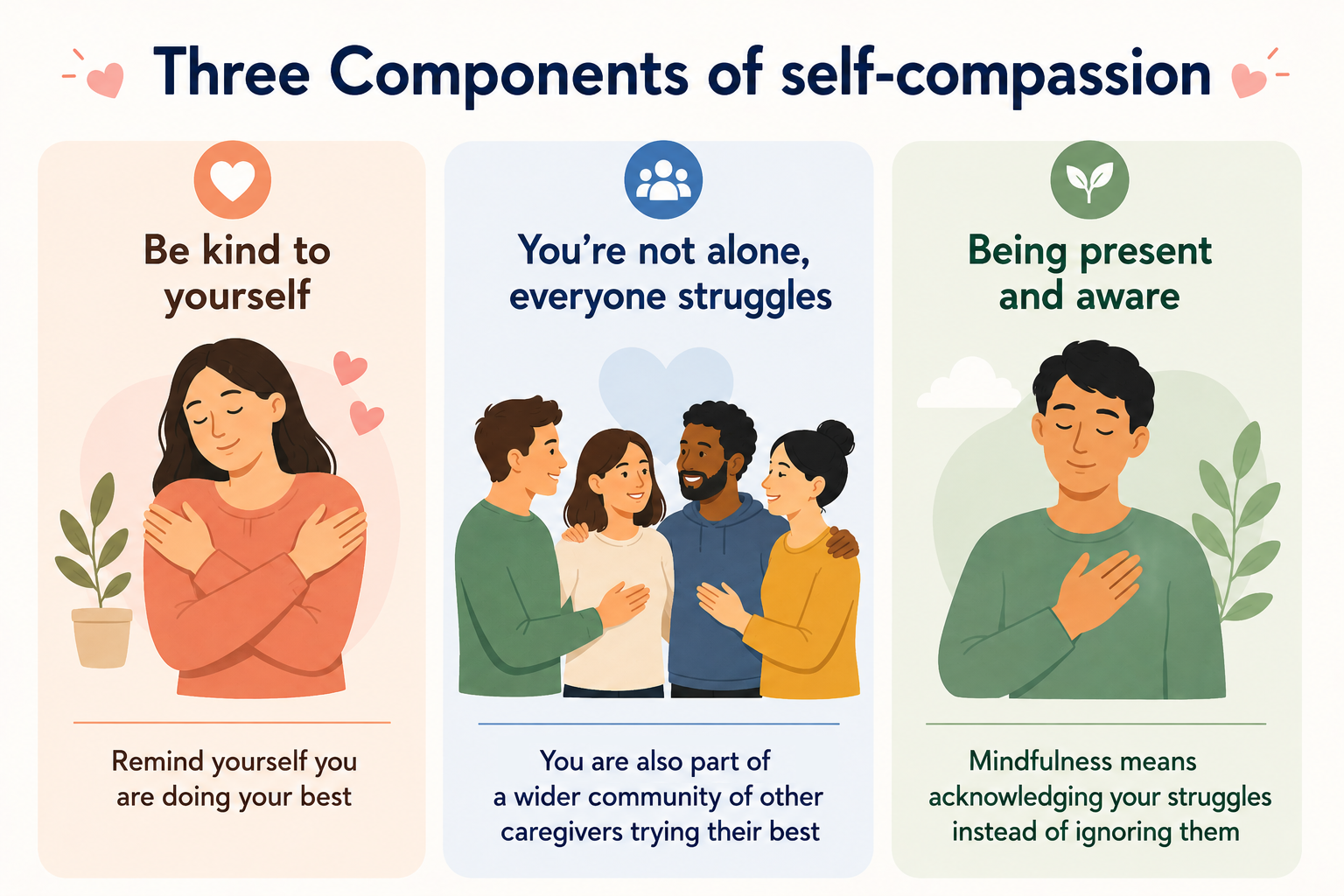
1. Be kind to yourself: We are often our harshest critics, focusing closely on our mistakes and shortcomings. Self-kindness is reminding yourself that you are doing your best. This means you respond to your struggles with understanding rather than judgment.
2. You’re not alone, everyone struggles: Hardships and difficulties are universal – everyone faces them. Everyone makes mistakes.
For caregivers, it may mean recognising that other caregivers also share similar emotional highs and lows, or uncertainties about their child’s wellbeing. This does not take away the uniqueness of your caregiving journey. Instead, this reminds you that you are also part of a wider community of other caregivers trying their best. This helps to reduce shame and isolation, making it easier to seek support and care.
3. Being present and aware: Mindfulness means acknowledging your struggles instead of ignoring them. Caregiving can feel overwhelming – almost as if you are being pulled in many directions at once. Mindfulness allows you to pause and pay attention to your feelings without judging them.
For instance, when your child is having a meltdown or tantrum, take a deep breath and notice your own emotions before responding.
Similarly, when you are unsure about making decisions about your child’s future, take a pause and say, “This is very hard for me right now”. This helps to reduce the pressure of reacting and handling tough situations right away. Instead, you can be grounded and respond with more clarity.
Ways to practise self-compassion
Here are some simple ways to practise self-compassion. There is no right or wrong way to do it. Pick the strategy that feels most helpful in the moment or that works best for you.
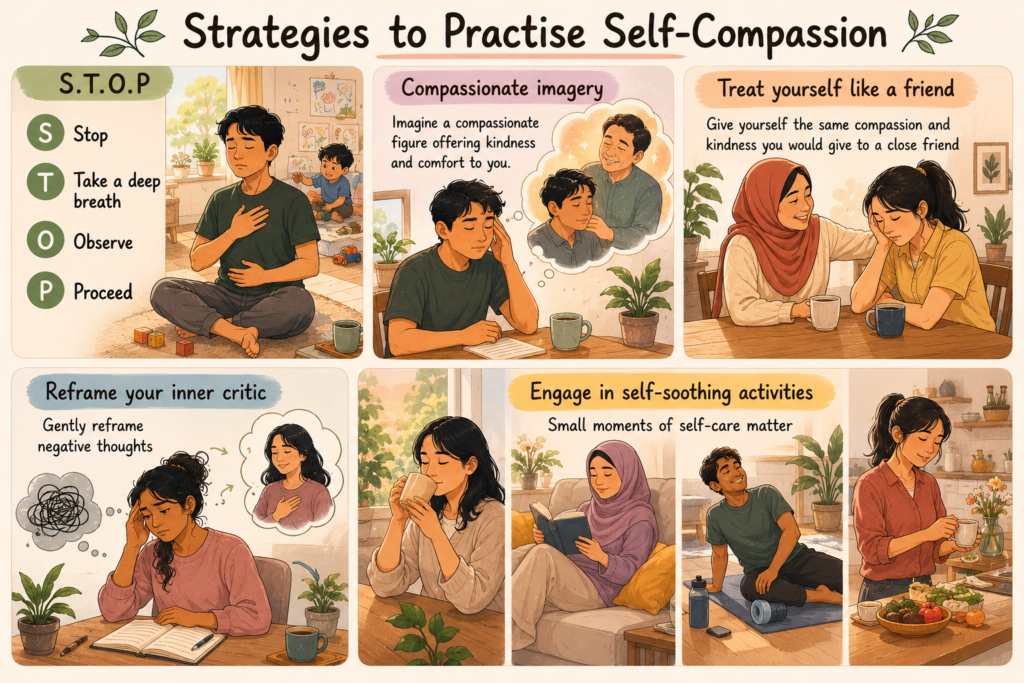
1. S.T.O.P
This is a simple strategy to use during emotionally charged moments. This helps you to respond in a calmer and more thoughtful manner.
- Stop – Pause and take a brief break from responding
- Take a deep breath
- Observe your thoughts, feelings and the situation – For example, “I noticed the thought, ‘This is too much, I’m losing control’ just flashed in my mind. I can feel my heart racing.”
- Proceed – Respond in a way that feels more grounded and calmer, rather than reacting right away.
2. Compassionate imagery
Recall a moment when you felt overwhelmed or blamed yourself. Then imagine a compassionate figure – it could be yourself, a loved one, or someone you trust – offering kindness and comfort to you. Picture them sitting next to you and offering you gentle reassurance such as, “This is a difficult thing to carry all by yourself. Remember to take care of yourself as well.” What kind words do they offer you? How do they comfort and reassure you?
3. Treat yourself like a friend
How would you respond to a close friend or loved one in a similar situation? How would you support them? Give yourself the same compassion and kindness. For example, “This is not an easy thing to face. You’re doing your best to care for your child.”
4. Reframe your inner critic
When thoughts like, “I’m such a failure” or “It’s all my fault that my child is like this” appear, gently reframe them. Instead, you can say, “Today was tough, and I reacted differently than I hoped. This does not make me a bad parent. I am trying my best.”
5. Engage in self-soothing activities
Small moments of self-care matter. A warm shower, soothing music or short breathing exercises can help. Make a simple list of activities that comfort you and intentionally include them in your routine.
References
Bazzano, A., Wolfe, C., Zylowska, L., Wang, S., Schuster, E., Barrett, C., & Lehrer, D. (2015). Mindfulness based stress reduction (MBSR) for parents and caregivers of individuals with developmental disabilities: A community-based approach. Journal of Child and Family Studies, 24(2), 298-308.
Boellinghaus, I., Jones, F. W., & Hutton, J. (2014). The role of mindfulness and loving-kindness meditation in cultivating self-compassion and other-focused concern in health care professionals. Mindfulness, 5(2), 129-138.
Finlay-Jones, A., Bluth, K., & Neff, K. (2023). Handbook of Self-Compassion. Springer Cham.
Neff, K. Self-Compassion Practices. Center for Mindful Self-Compassion.
Neff, K., & Germer, C. (2017). Self-compassion and psychological well-being. In The Oxford handbook of compassion science. (pp. 371-385). Oxford University Press.
Neff, K. D., & Faso, D. J. (2015). Self-compassion and well-being in parents of children with Autism. Mindfulness, 6(4), 938-947.
Risi, A. A.-O., Pickard, J. A., & Bird, A. L. The implications of parent mental health and wellbeing for parent-child attachment: A systematic review. (1932-6203 (Electronic)).
Saulsman, L., Campbell, B., & Sng, A. (2017). Building Self-Compassion; From Self-Criticism to Self-Kindnesss. Centre for Clinical Interventions.
Shafeeq, S. (2024). 65% of parents of kids with development needs require professional mental health support: Study. The Straits Times.
Wong, C. C. Y., Mak, W. W. S., & Liao, K. Y.-H. (2016). Self-compassion: A potential buffer against affiliate stigma experienced by parents of children with autism spectrum disorders. Mindfulness, 7(6), 1385-1395.