
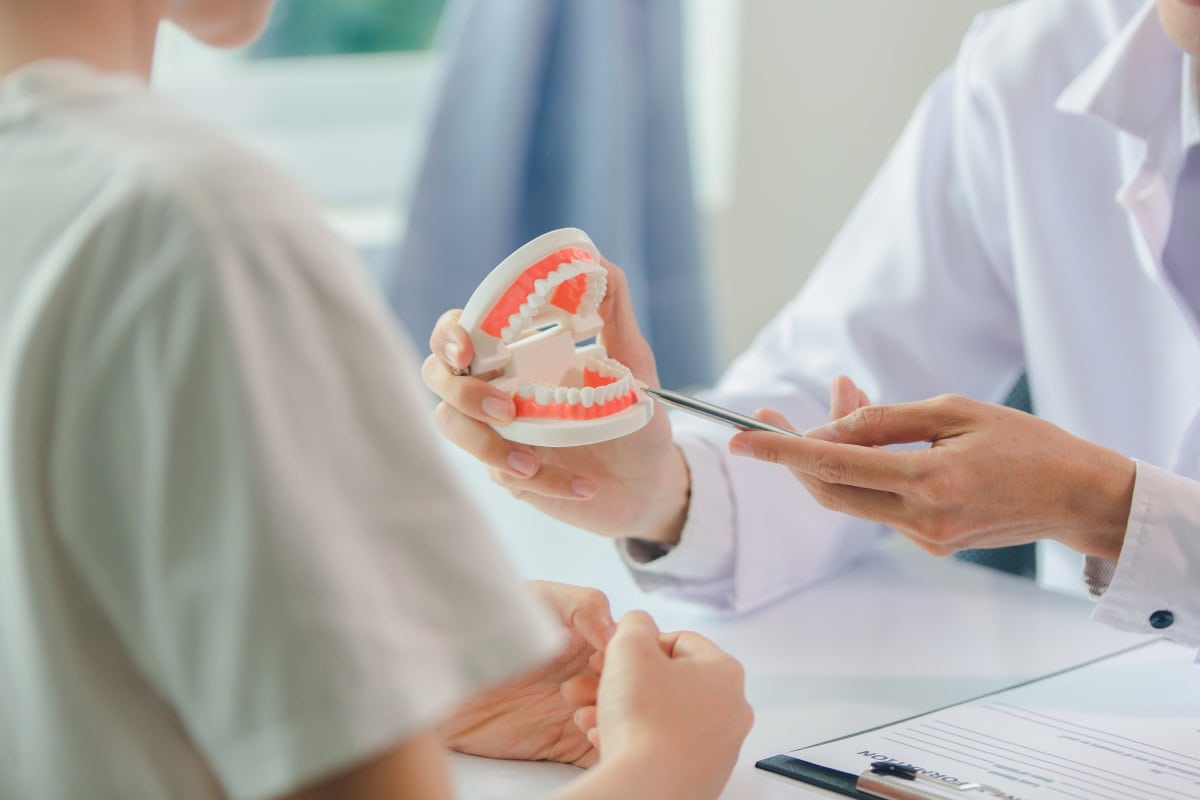
Teeth do more than complete a smile. Having good teeth alignment (occlusion) supports facial and speech development, as well as overall oral health and function [1]. When teeth are misaligned, or known as malocclusion, it can lead to difficulties in chewing, speaking and other dental issues such as decay and gum disease [2].
Malocclusion can occur in both mild and severe forms in the general population, with prevalence ranging from 22 to 76 per cent [7,8] However, it is more common among individuals with disabilities [3,4], reaching as high as 95 per cent or more in children [5,6].
This high prevalence of malocclusion in people with disabilities is linked to factors such as genetics, higher risk of dental injuries, habits such as finger sucking or mouth breathing, difficulties with oral hygiene, limited access to dental care, congenital orofacial defects and cultural factors [9,10,11,12].
While there is limited data on the prevalence of malocclusion among persons with disabilities, research shows that those with Down syndrome and cerebral palsy are most affected, with rates above 90 per cent. On the other hand, those with sensory or physical disabilities show lower rates, between 27 to 58 per cent. [15, 16]
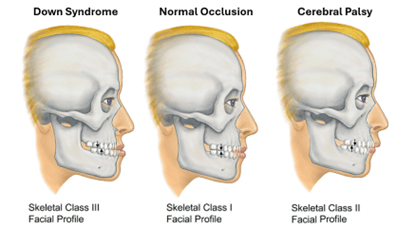
Jaw and bite patterns. Photo credit: ResearchGate
Why malocclusion is common in Down syndrome
Down syndrome is a genetic condition that can affect both physical features and intellectual development. Common physical characteristics of Down syndrome may affect the growth of teeth and jaws, resulting in malocclusion.
- People with Down syndrome often have a smaller upper jaw (maxilla) and a larger lower jaw (mandible), which creates a concave facial profile. This can cause the lower front teeth to cover the top front teeth (anterior crossbite) or crossbites on one or both sides of the back teeth. [20,21]
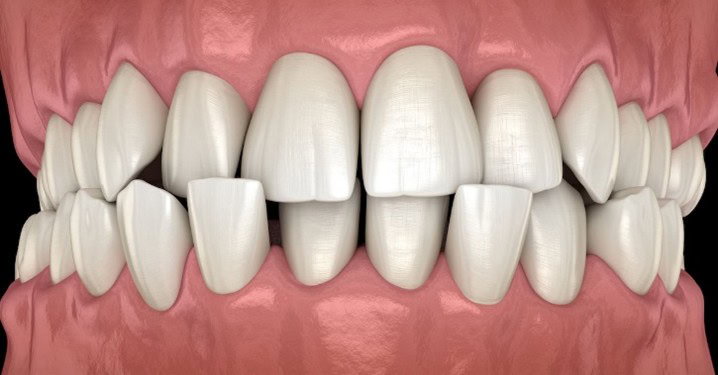
- Upper teeth may also be crowded due to limited space, missing or irregularly shaped teeth or teeth erupting later than usual. This may lead to problems with how they fit together. [20,21]
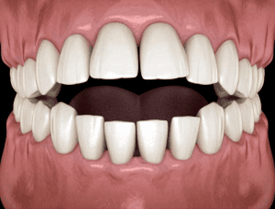
- Individuals with Down syndrome may have a larger tongue (macroglossia) that sits more forward in the mouth, making it harder to close the lips. This causes an open bite, where the upper and lower front teeth do not touch or overlap. [20,21]
Why malocclusion is common in cerebral palsy
Cerebral palsy is a condition that affects movement and posture due to damage to the developing brain. Children with cerebral palsy are more likely to have malocclusion for several reasons:
- Uncoordinated mouth movements and muscle weakness can cause teeth to become misaligned
- Loss of muscle function may cause the tongue to push forward and prevents the top and bottom front teeth from meeting, causing an open bite
- Some individuals have deep bites, where their top front teeth completely cover the bottom front teeth, leading to a risk of dental injuries. [22-25]
Managing malocclusion
Before starting treatment, dentists and doctors need to evaluate the patient’s ability to cooperate and tolerate procedures. Orthodontic treatment can benefit individuals with Down syndrome and cerebral palsy, but patients and their caregivers must commit to maintaining daily oral hygiene. [26-28]
With advances in dental materials and behavioural therapy today, dental care can start earlier and be managed more smoothly. Dentists can help to minimise malocclusion in patients through preventive procedures such as caries control, managing premature teeth loss, and promoting good oral habits. They can also use interceptive procedures, such as correcting bite problems or guiding jaw growth. With timely care and a strong partnership between families and dental professionals, the chances of serious dental problems can be reduced. [26-28]
Conclusion
Oral health is increasingly recognised as a foundation for general health, wellness, and is a key factor in the success of dental treatments. Caregivers play a crucial role in supporting the oral care of individuals with disabilities at home. In turn, dentists provide treatment to improve oral health, and guide caregivers in building good home oral health routines. With careful attention, prevention and management of bite and alignment issues, the quality of life of individuals with disabilities can be greatly improved.
—–
This article is contributed by Dr Sneha Sundar Rajan. Dr Sneha has a master’s degree in dental surgery (MDS) from Manipal University, India. She was a researcher with the National University of Singapore at the Faculty of Dentistry and Centre for Advanced 2D materials before taking a break for motherhood.
Reference
- https://bellevuehilldental.com.au/what-is-occlusion-in-dentistry/#:~:text=Importance%20of%20Occlusion,a%20less%20appealing%20look%20overall.
- https://kidsdentalstudio.org/2023/05/09/misalignment-or-malocclusion-teeth-can-impact-your-childs/#:~:text=Malocclusion%20teeth%20refer%20to%20teeth,self%2Desteem%20and%20confidence%20issues.
- Oreland A, Heijbel J, Jagell S. Malocclusions in physically and/ or mentally handicapped children. Swed Dent J. 1987;11(3):103- 19.
- Franklin DL, Luther F, Curzon MEJ. The prevalence of malocclusion in children with cerebral palsy. Eur J Orthod. 1996 Dec;18(6):637-43.
- Abdul-Rahim FS, Mohamed AM, Nor MM, Saub R (2014) Malocclusion and orthodontic treatment need evaluated among subjects with Down syndrome using the Dental Aesthetic Index (DAI). Angle Orthod. 84(4): 600-6.
- Vigild M (1985) Prevalence of malocclusion in mentally retarded young adults. Community Dent Oral Epidemiol. 13(3): 183-184.
- Al-Sarheed M, Bedi R, Hunt NP (2003) Orthodontic treatment need and self-perception of 11–16-year-old Saudi Arabian children with a sensory impairment attending special schools. J Orthod. 30(1): 39-44.
- Grippaudo C, Pantanali F, Paolantonio EG, Grecolini ME, Saulle R, et al., (2013) Prevalence of malocclusion in Italian schoolchildren and orthodontic treatment need. Eur J Paediatr Dent. 14(4): 314-318.
- Mitsea A, Karidis A, Donta-Bakoyianni C, Spyropoulos N (2002) Oral health status in Greek children and teenagers, with disabilities. J Clin PediatrDent. 26(1): 111-118.
- Bradley C, McAlister T (2004) The oral health of children with Down syndrome in Ireland. Spec Care Dentist. 24(2): 55-60.
- Corruccini RS (1984) An epidemiologic transition in dental occlusion in world populations. Am J Orthod. 86(5): 419-426.
- Waldman HB, Perlman SP, Swerdloff M (2000) Orthodontics and the population with special needs. Am J Orthod Dentofacial Orthop. 118(1): 14-17.
- Vittek J, Winik S, Winik A, Sioris C, Tarangelo AM, et al., (1994) Analysis of orthodontic anomalies in mentally retarded developmentally disabled (MRDD) persons. Spec Care Dentist. 14(5): 198-202.
- Vigild M (1985) Prevalence of malocclusion in mentally retarded young adults. Community Dent Oral Epidemiol. 13(3): 183-184.
- Al-Sarheed M, Bedi R, Hunt NP (2003) Orthodontic treatment need and self-perception of 11–16-year-old Saudi Arabian children with a sensory impairment attending special schools. J Orthod. 30(1): 39-44.
- Dinesh RB, Arnitha HM, Munshi AK (2003) Malocclusion and orthodontic treatment need of handicapped individuals in South Canara, India. Int Dent J. 53(1): 13-18.
- Quintanilha JS, Biedma BM, Rodriguez MQ, Mora MT, Cun-queiro MM, Pazos MA. Cephalometrics in children with Down’s syndrome. Pediatr Radiol 2002; 32:635-43.
- Hennequin M, Allison PJ, Veyrune JL. Prevalence of oral health problems in a group of individuals with Down syndrome in France. Dev Med Child Neurol 2000; 42:691-8.
- Venail F, Gardiner Q, Mondain M. ENT and speech disorders in children with Down’s syndrome: an overview of pathophysiol-ogy, clinical features, treatments, and current management. Clin Pediatr (Phila) 2004; 43:783-91.
- Nair et al.; JOMAHR, 2(2): 42-50, 2017 DENTAL CONSIDERATIONS IN PATIENTS WITH DOWN SYNDROME.
- Nirmala SVSG, Saikrishna D (2017) Dental Concerns of Children with Down’s Syndrome – An Overview. J Pediatr Neonatal Care 6(3): 00248.DOI: 10.15406/jpnc.2017.06.00248
- Sankar C, Mundkur N. Cerebral palsy‑definition, classification, etiology and early diagnosis. Indian J Pediatr 2005;72:865‑8.
- Rosenbaum CH, McDonald RE, Levitt EE. Occlusion of cerebral‑palsied children. J Dent Res 1966;45:1696‑700.
- Carmagnani FG, Gonçalves GK, Corrêa MS, dos Santos MT. Occlusal characteristics in cerebral palsy patients. J Dent Child (Chic) 2007;74:41‑5.
- Dougherty NJ. A review of cerebral palsy for the oral health professional. Dent Clin North Am 2009;53:329‑38, x.
- Mani SA, Mote N, Kathariya M, Pawar KD. Adaptation and Development of Dental Procedure in Cerebral Palsy, Pravara Med Rev 2015;7:17-22.
- Becker A, Shapira J. Orthodontics for the handicapped child. Eur J Orthod 1996;18:55‑67.
- Musich DR. Orthodontic intervention and patients with down syndrome. Angle Orthod 2006;76:734‑5.